
Advanced Plumbing and Rooter Service Texas is a search term commonly used by homeowners, landlords, property managers, and business owners who need help with a plumbing leak, blocked drain, damaged sewer line, overflowing fixture, water-heater problem, or another urgent plumbing concern. The right service should do more than temporarily clear a symptom. It should identify the likely cause, explain the available options, protect the surrounding property, and complete the work according to the conditions found on site.
Texas properties vary widely. A customer may be maintaining a suburban home, rural property, rental unit, restaurant, office, warehouse, or newly constructed building. Each property has a different plumbing layout, water demand, drainage system, access condition, and repair history. Heat, storms, changing soil conditions, mineral content, aging pipe materials, and heavy fixture use may also influence plumbing performance.
This guide explains how professional plumbing and rooter work is evaluated, what common services include, what affects project cost, and what customers should ask before authorizing work. It also helps readers distinguish a basic fixture repair from a drain, sewer, water-line, or emergency plumbing problem.
Readers should be able to move naturally between the plumbing homepage, plumbing repair services, plumbing information resources, and service-request page.
What Is Advanced Plumbing and Rooter Service Texas and Why Does It Matter?
Advanced Plumbing and Rooter Service Texas describes professional help for the pipes, fixtures, drains, sewers, water heaters, valves, and related components that move water into a property and wastewater away from it. Plumbing service generally focuses on supply lines, fixtures, equipment, leaks, and connections. Rooter service focuses more directly on blocked or restricted drain and sewer lines, although the two areas often overlap.
A slow kitchen sink may be limited to one fixture, while several slow drains may indicate a larger branch-line or main-line restriction. Water appearing near a wall could come from a visible fixture connection, a concealed supply pipe, a drain, or another source. A qualified plumber should gather information, inspect accessible components, and avoid presenting an unverified cause as fact.
People searching for Texas plumbing services often need a broad provider capable of handling repairs, diagnostics, installations, and urgent calls. Someone searching for rooter service Texas is usually more focused on clogged drains, recurring backups, tree-root intrusion, grease buildup, foreign objects, or damaged sewer piping. A drain cleaning company Texas may use cabling, sectional equipment, hydro-jetting, camera inspection, or other methods based on the line and obstruction. An emergency plumber Texas search often involves active leaks, sewer backups, no water, overflowing fixtures, or another problem that cannot reasonably wait.
Texas consumers can verify plumbing credentials and search for qualified professionals through the Texas State Board of Plumbing Examiners. Customers should confirm applicable licensing and insurance information before authorizing major plumbing work.
Local plumbing matters because a failure can affect more than one fixture. Escaping water may reach cabinets, flooring, drywall, stored items, electrical components, or neighboring units. A sewer problem may interrupt restroom access and create sanitation concerns. A failed shutoff valve can make a small repair more complicated. Early diagnosis helps the customer understand whether the issue requires a minor correction, drain cleaning, excavation, repiping, equipment replacement, or further investigation.
Advanced Plumbing and Rooter Service Texas: Common Problems and Service Options
Advanced plumbing and rooter service texas should begin with a clear description of the symptoms. The location of the problem, number of affected fixtures, age of the system, previous repairs, sounds, odours, visible water, and changes in water pressure can all help guide the inspection. Customers should not assume that every slow drain needs the same equipment or that every leak requires complete pipe replacement.
The table below summarizes common plumbing concerns and the type of professional response that may be considered. It is a planning guide rather than a diagnosis for a specific property.
| Plumbing concern | Possible service approach | Important evaluation point |
| One slow sink or tub | Fixture trap or branch-drain cleaning | Determine whether other fixtures are affected |
| Multiple slow drains | Main or secondary line inspection | Check for a shared restriction |
| Recurring sewer backup | Camera inspection and rooter service | Identify damage, roots, buildup, or poor flow |
| Active water leak | Isolation, leak detection, and pipe repair | Protect the building before permanent repair |
| Low water pressure | Supply, valve, fixture, or pressure review | Compare one fixture with the whole property |
| Running toilet | Fill valve, flapper, seal, or internal repair | Confirm whether water is continuously moving |
| No hot water | Water-heater diagnosis | Review energy source, controls, and equipment condition |
| Damaged sewer line | Spot repair, lining, or replacement planning | Confirm location and extent of damage |
| Commercial restroom issue | Fixture, drain, flush valve, or supply repair | Minimize disruption to occupants |
| Plumbing emergency | Immediate containment and diagnosis | Address safety and property protection first |
Advanced plumbing and rooter service texas may involve more than one stage. A plumber may first stop active water, restore limited use, or clear an obstruction. A more complete repair may follow after the pipe is inspected, parts are obtained, access is created, or the customer approves a written scope.
The most useful service recommendation identifies what is known and what remains uncertain. For example, a drain may be opened successfully, but a camera inspection may still be appropriate if the blockage repeatedly returns. A leaking section may be repaired, but other deteriorated piping could require separate planning. Clear communication helps customers make decisions without assuming that one repair guarantees the condition of the entire system.
Why Choose a Professional Advanced Plumbing and Rooter Service in Texas?
Advanced plumbing and rooter service texas should be selected based on verified qualifications, diagnostic process, communication, and the suitability of the proposed repair. A low initial quote is not useful when it excludes access, restoration, equipment, permits, or the work needed after the immediate symptom is addressed.
A professional provider should explain how the problem will be investigated and what information the customer will receive before additional work begins.
- Verify the plumbing company and responsible license holder.
- Request a clear description of the work being proposed.
- Ask whether diagnosis, equipment, access, and cleanup are included.
- Confirm how additional damage or hidden conditions will be handled.
- Discuss whether permits or inspections may be required.
- Keep invoices, photographs, and equipment information.
- Avoid guarantees that are not supported by the actual system condition.
Professional service also includes respect for the property. Work areas should be protected where practical, shutoffs should be operated carefully, removed components should be discussed, and the completed repair should be tested under relevant conditions.
The provider should also help the customer distinguish urgent work from optional improvement. An active supply-line leak needs containment. A sewer backup may require immediate restriction of fixture use. An aging water heater that is still operating may allow more time for comparison and planning. This prioritization helps customers use their budget more effectively.
Infographic Image Brief: Create an infographic showing a Texas property’s main plumbing systems: water service line, shutoff valve, fixtures, water heater, branch drains, main sewer, cleanout, camera inspection, rooter equipment, and emergency isolation steps.
Suggested Alt Text: Advanced plumbing and rooter service Texas system showing water lines, drains, sewer inspection, and emergency repairs.
How Advanced Plumbing and Rooter Service Texas Works
Advanced Plumbing and Rooter Service Texas normally follows a sequence that moves from symptom review to testing, repair, and final verification. The exact process changes according to the problem, but a structured approach reduces guesswork.
Step 1: Customer Problem Review
The plumber asks when the issue began, which fixtures are affected, whether the problem is constant or intermittent, and what previous work has been performed. Customers should mention unusual sounds, odors, visible water, pressure changes, or recurring backups.
Step 2: Property and System Inspection
Accessible fixtures, shutoff valves, pipes, drains, cleanouts, equipment, and affected surfaces are reviewed. The plumber may compare nearby fixtures to determine whether the issue appears isolated or system-wide.
Step 3: Immediate Containment
If water is actively escaping, the first priority may be shutting off a fixture, branch, appliance, or main supply. For a sewer backup, fixture use may need to stop until flow is restored.
Step 4: Diagnostic Testing
Depending on the concern, testing may include pressure checks, visual inspection, drain cabling, camera inspection, electronic leak detection, dye testing, fixture disassembly, or equipment diagnostics.
Step 5: Findings and Scope
The customer should receive an explanation of what was observed, what the plumber believes is causing the problem, and what limitations remain. The proposed repair should state the included work and any likely additional conditions.
Step 6: Repair or Cleaning
The plumber performs the approved repair. This may involve replacing a valve, rebuilding a fixture, clearing a drain, repairing a pipe, servicing a water heater, hydro-jetting a line, or preparing for sewer replacement.
Step 7: Operational Testing
The repaired system is tested under normal use where practical. Drains may be flowed, fixtures operated, connections checked, and pressure or temperature reviewed.
Step 8: Customer Guidance
The customer should understand what was repaired, whether any related concerns remain, and what warning signs should trigger another service call.
A rooter service should not automatically be treated as a permanent sewer repair. Opening the line restores flow, while inspection helps determine why the restriction developed. In some cases, grease or debris may be the main concern. In others, roots, offsets, bellies, corrosion, or broken piping may require a longer-term solution.
Advanced Plumbing and Rooter Service Texas Cost and Requirement Factors
Advanced plumbing and rooter service texas pricing depends on the actual problem, property access, equipment required, time of service, parts, pipe material, depth, and whether walls, floors, concrete, soil, or landscaping must be opened. A responsible article should not promise one fixed price for every Texas property.
| Cost factor | Why it matters | Questions to ask |
| Type of problem | Fixture repairs differ from underground sewer work | What system is affected? |
| Diagnostic equipment | Cameras and leak detection add information | Is testing included in the quote? |
| Access | Concealed or buried piping takes longer to reach | Who handles opening and restoration? |
| Pipe material | Copper, PVC, cast iron, PEX, and other materials require different methods | Is the replacement compatible? |
| Emergency timing | Nights, weekends, or urgent dispatch may be priced differently | Is there a dispatch or after-hours charge? |
| Line length and depth | Longer or deeper repairs require more labor and equipment | How much of the line is included? |
| Permit requirements | Some replacements require local approval | Who obtains the permit? |
| Cleanup and restoration | Plumbing repair may disturb surfaces | What restoration is excluded? |
| Warranty terms | Coverage varies by company and repair type | What is covered in writing? |
| Additional damage | Hidden deterioration can change the scope | How are change orders approved? |
Advanced plumbing and rooter service texas estimates are easiest to compare when each provider is pricing the same scope. One estimate may include camera inspection, excavation, disposal, permit coordination, and testing. Another may include only the immediate repair.
Customers should ask for the repair location, materials, included labor, excluded restoration, payment terms, and warranty language in writing. When a company cannot confirm the full condition until access is created, the estimate should explain how additional work will be authorized.
Advanced Plumbing and Rooter Service Texas Tips for Property Owners
Preparation can make a plumbing appointment more efficient and help protect the property before the technician arrives. Customers should never take unsafe steps around sewage, electrical hazards, gas, hot water, or unstable surfaces.
- Locate the main water shutoff before an emergency occurs.
- Stop using fixtures when wastewater is backing up.
- Move stored items away from an active leak when safe.
- Record when and where the problem appears.
- Avoid repeated chemical drain-cleaner use.
- Keep access to fixtures, cleanouts, and equipment clear.
- Verify credentials before authorizing major work.
Take photographs of visible damage and keep previous invoices when possible. A repair history can help the plumber recognize repeated problems. For commercial properties, record which tenants, restrooms, or floors are affected.
Chemical drain products may not solve solid obstructions, roots, damaged piping, or larger sewer problems. They may also complicate later service depending on the product and quantity used. Tell the plumber about anything placed into the drain.
Preventive attention also matters. Small fixture leaks, loose toilets, slow drains, noisy water heaters, and changing pressure can provide early warning. Addressing these concerns before a complete failure may reduce disruption.
Texas Plumbing Systems, Weather, and Long-Term Planning
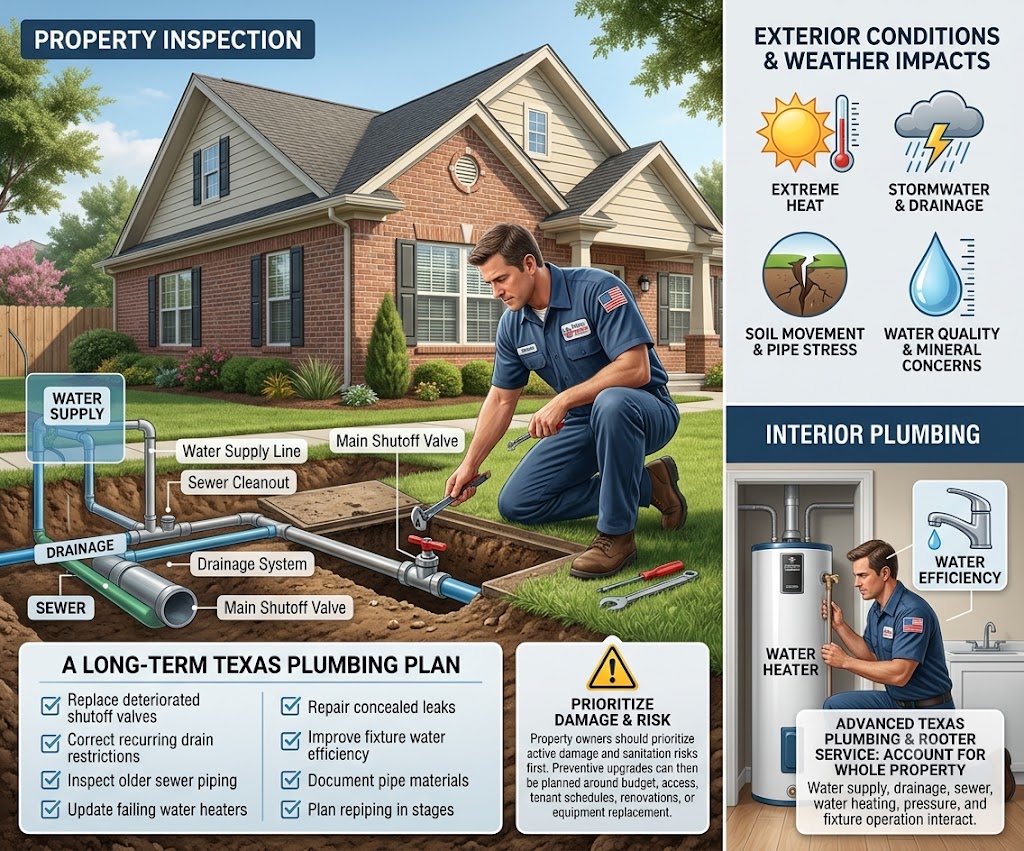
Advanced plumbing and rooter service texas should account for the whole property rather than treating each fixture as unrelated. Water supply, drainage, sewer, water heating, pressure, and fixture operation interact with each other.
Exterior conditions can also affect plumbing. Soil movement may place stress on buried lines. Storms and drainage conditions may contribute to groundwater or sewer concerns. Outdoor piping and equipment may be exposed to temperature changes. Water quality can influence scale and fixture maintenance.
A long-term plumbing plan may include replacing deteriorated shutoff valves, correcting recurring drain restrictions, inspecting older sewer piping, updating failing water heaters, repairing concealed leaks, improving fixture water efficiency, documenting pipe materials, and planning repiping in stages.
Property owners should prioritize active damage and sanitation risks first. Preventive upgrades can then be planned around budget, access, tenant schedules, renovations, or equipment replacement.
FAQs About Advanced Plumbing and Rooter Service Texas
Advanced plumbing and rooter service texas questions commonly involve price, response time, drain-cleaning methods, sewer inspection, licensing, and repair requirements. The answers below provide general guidance, but an on-site diagnosis is needed for a specific property.
How much does plumbing and rooter service cost in Texas?
Cost depends on the problem, access, time of service, equipment, parts, pipe condition, and whether excavation or restoration is needed.
Request a written estimate that explains what is included and how additional work will be approved.
How long does rooter service take?
A straightforward fixture or branch-line obstruction may be addressed during one visit. A main sewer problem, damaged line, or difficult access can take longer.
Inspection may also reveal the need for a separate repair project.
Does a cleared drain mean the sewer is permanently fixed?
Not always. Clearing restores flow, but the cause may remain.
Recurring backups may justify camera inspection or further evaluation of roots, buildup, offsets, or damaged pipe.
What should I do during an active plumbing leak?
When safe, stop fixture use and shut off the affected supply or main water valve.
Keep people away from electrical hazards and contact a professional plumber.
How do I verify a Texas plumber?
Use the Texas State Board of Plumbing Examiners public resources to check the responsible license holder and company information.
Ask the provider to identify the Responsible Master Plumber connected to the work.
Do plumbing repairs require permits?
Permit requirements depend on the type of work and local authority.
Major replacements, new installations, and certain sewer or water-line projects may require permits and inspections.
When should sewer replacement be considered?
Replacement may be considered when inspection identifies severe deterioration, collapse, repeated root entry, major offsets, or another condition that cannot be resolved through cleaning alone.
The repair method should be based on confirmed findings.
Contact Information
Advantage Plumbing Plus, LLC
Phone: 7153597473
Email: advantageplumbingplus@gmail.com